

Business+Impact Co-Hosts 2nd Annual ESG Dilemma Design Challenge
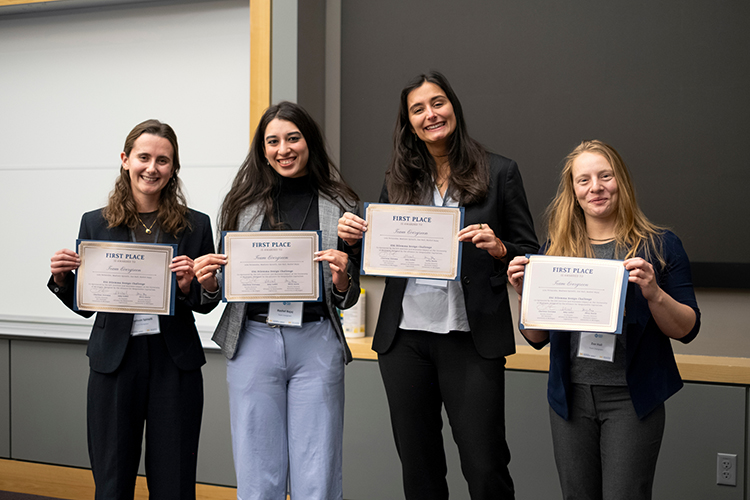
First Prize Winning Team Evergreen (left to right: Madison Spinelli, Rashel Bajaj, Lola Fernandez, and Zoe Hall)
Ann Arbor, February 10, 2026 – The Alliance for Responsible Capitalism hosted its second annual ESG Dilemma Design Challenge — emphasizing how companies can address their systemic climate risk while navigating stakeholder pressures. Co-sponsored by Business+Impact and the Erb Institute, the challenge began in October 2025 with 15 colleges represented and culminated with an in-person final pitch competition between four teams on February 7, 2026 at the Ross School of Business at the University of Michigan.
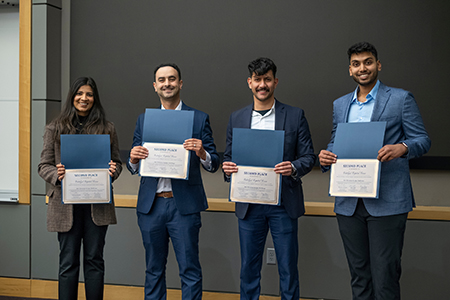
Second Place Team Catalyst Capital Crew (left to right: Devinaa Mangal, Ridha Al-Wishah, Venkatasai Canchi, and Nithin Donepudi )
The judging team did not know the schools each team hailed from, and used a blind judging rubric. Business+Impact is proud to announce that Team Evergreen from UC Berkeley (Lola Fernandez, Madison Spinelli, Zoe Hall, and Rashel Bajaj) won the competition and the first prize of $10,000.
The second prize honorarium of $5,000 was won by TeamCatalyst Capital Crew from University of Michigan. The team included Ridha Al-Wishah (MBA), Devinaa Mangal (MBA), Venkatasai Canchi (MBA), and Nithin Donepudi (MBA). Team Carbon Caps, Captures, and Capital from University of Michigan (Diego Fernandez [MBA], Jamie Waterman [MBA/MS], Wendy Palomino [MBA/MS] and Lydia Christian [MBA/MS]) took the third place prize of $2,500.

Third Place Team Carbon Caps, Captures, and Capital (left to right: Wendy Palomin0, Lydia Christian, Diego Fernandez, and Jamie Waterman)
Banks recognize the material risks of climate change to business, with the potential for tens of trillions of economic losses annually. For the challenge, teams were tasked with developing a strategy for how the bank might use its influence – in the private sector, on public policy, and with its full range of stakeholders, including regulators and elected officials – to create a business landscape that motivates sustainable behavior. The plan needed to (1) identify specific, salient pieces of public policy that either magnify or reduce market failures related to climate change and (2) enable the bank to effectively influence these pieces of public policy while mitigating backlash and legal risks. This strategy needs to be pragmatic and grounded in the reality of today’s political environment.
Special thanks to the other colleges represented in the competition, which included Bard College, Columbia University, Fordham University, Harvard University, HEC Paris, INCAE, L. D. College of Engineering, MIT, Stanford, UC Berkeley, the University of Chicago, the University of Southern California, UPenn, and Yale University.
The judging panel included a who’s who of the banking and capital markets industries:
- Scott Beckerman, Comerica
- Joe Pigg, American Bankers Association
- Chad Spitler, Third Economy
- Matt Elliott, Bank of America
- Annalisa Barrett, KPMG
- Marcos Mancini, UNDP
- Luisa Brasil, CPD, Capital Asset Markets
- Elizabeth Doty, Third Side Strategies
- Lauren Bigelow, Michigan Ross