

Socent Spotlight: Zan Times
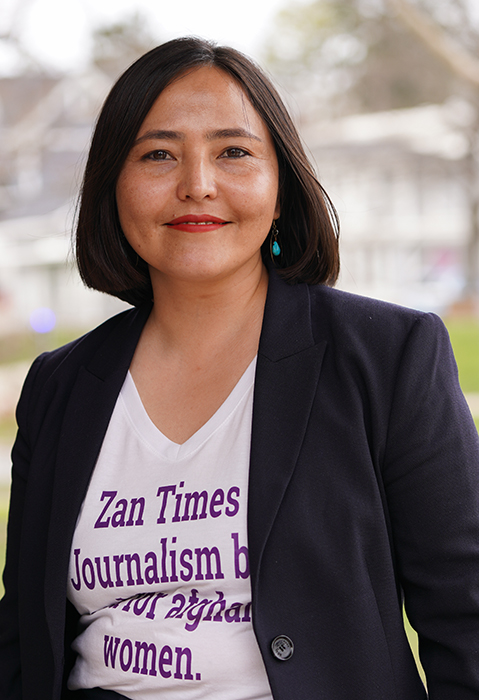
Zahra Nader (Photo by Dieu-Nalio Chery)
This is part of a Business+Impact series on U-M students and alumni who have created social enterprises and continue the work of entrepreneurship outside of school. For this edition, we are shining the light on Zan Times — an independent, non-profit news organization on a mission to empower women journalists in Afghanistan.
Since the Taliban took over Afghanistan in August 2021, women and other marginalized groups have faced systematic repression, violence, and the complete erasure of their social and political rights. Zan Times was born out of this moment of desperation, of anger, of us trying to speak our truth in the face of injustice, and brute violence suppressing us for who we are. Zan Times was born out of the need to reclaim our autonomy and self-determination, to seek ways to shape and define the future we want to live in and fight for equality and freedom for all.
What does Zan Times do, and when/where was it founded?
Zan Times is an independent, Afghan women-led investigative newsroom. I founded it in exile in August 2022, a year after the Taliban returned to power, and I run it from Edmonton, Alberta. We do human rights reporting with a focus on women and LGBTQ people in Afghanistan. Our journalists work both inside the country, under pseudonyms, and in exile, and we co-publish regularly with international outlets including The Guardian.
What inspired you to create this business? How desperate is the situation on the ground in Afghanistan?
When the Taliban took Kabul in August 2021, Afghan newsrooms emptied out. Women journalists were pushed out of the profession, and the reporting that survived was largely written about Afghan women rather than by them. I started Zan Times because I believed the people best placed to document what was happening to Afghan women were Afghan women themselves.
The situation on the ground is desperate in ways that are hard to convey. Girls are barred from school beyond grade six and from university entirely. Women cannot travel without a male guardian, work in most sectors, or speak in public. Maternal healthcare has collapsed in much of the country. This month we published an investigation, co-published with The Guardian, documenting 231 cases of femicide across ten provinces since August 2021, and that is only what we could verify. Our own reporters live under these restrictions while doing the work.

Zahra Nader speaks at The Hazards of Reporting on Human Rights Abuses: A Roundtable with moderator Susan D. Page, Weiser Diplomacy Center Ambassador
What courses or UM entrepreneurship programs (like the Impact Studio) have helped you the most in building out your business?
The Impact Studio, through the founders’ program, was genuinely formative. During my semester there I worked with MBA students, and they helped me think about structure and systems. I learned that an organization needs systems, strategies, and mechanisms to operate and project its future work. I came to Michigan as a journalist. I left thinking like someone building an institution. Ever since I returned to Zan Times, the business side of the newsroom has been part of my focus, and that shift started at Michigan.
You are putting yourself in danger regularly, and your reporters on the ground are putting themselves in danger. What sort of things make these risks worth it?
Because the alternative is silence, and silence is exactly what the Taliban want. If no one documents what is happening to Afghan women, then in twenty years there will be no record, no evidence, no accountability, and no way for Afghan women to prove what was done to them. Every case our reporters verify becomes part of a historical record that cannot be erased.
I also want to be clear that we do not romanticize risk. I tell every one of our journalists the same thing: your safety matters more than any story. Never risk your life for a report. We run trauma-informed journalism for our team, because carrying other people’s pain has a cost.
What is a recent milestone, and what are your future plans for Zan Times?
Honestly, the milestone is that Zan Times has survived four years. We have kept an Afghan newsroom, staffed mostly by Afghan women journalists, running continuously for four years without significant funding. In this environment, survival itself is the achievement. Plus, we have now trained more than 80 Afghan women to become journalists. They are now, part of our network of freelancers in the country.
Our future plan is to build Zan Times into a reader-supported newsroom. Last year, when US cuts its funding, we lost half our budget overnight. That taught us that if we depend on grants, our future is fragile. If the grant disappears, the work disappears. So we are asking readers to support our work monthly for the price of a latte. That is what we are inviting people to do this year: become a monthly supporter of Zan Times and support the work of Afghan women journalists.

Zahra Nader with her husband (Photo by Dieu-Nalio Chery)
What do you want the world to understand about Afghan women?
That Afghan women are not passive victims. They are fighters in their own right, and they are survivors. The circumstances in which they live may be different from those of women elsewhere, but the fact that Afghan women are organizing indoors, running secret schools, and doing underground journalism is evidence that they are fighting for their own survival, their own rights, and their own freedom. Our job is not to speak for them. It is to make sure the world hears them.
Key Media from the Zan Times newsletter (sign up here)